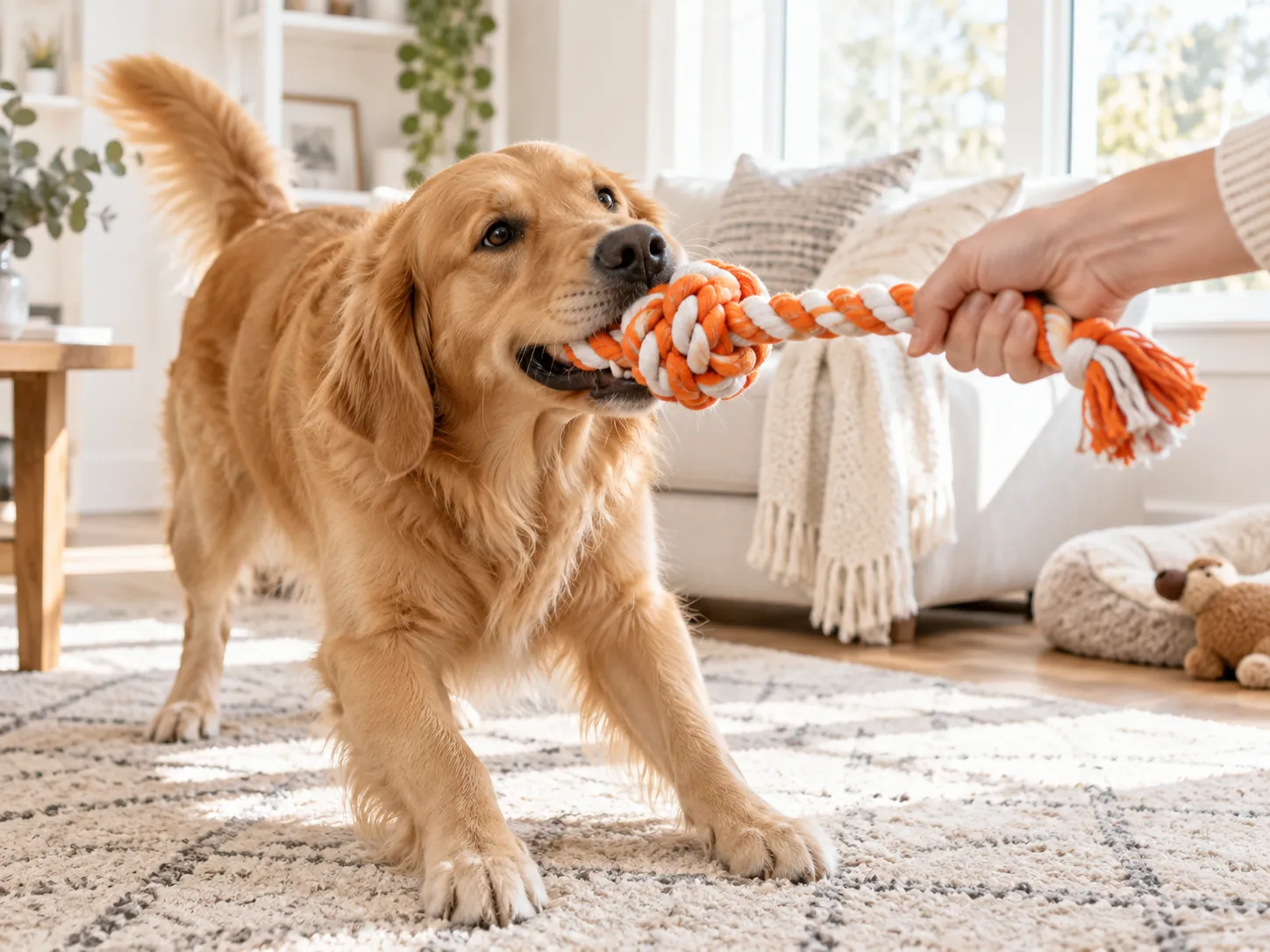
Safe tug is a cooperative game: invite your dog to grab a suitable toy, keep the pull low and gentle, pause often, and trade rather than wrenching the toy away. Watch your dog's movement and comfort throughout. The AKC's tug guidance describes well-managed tug as a useful play and training activity, while warning against rough technique and awkward neck or spine positions.
Set up the game before you pull
Choose a toy long enough to give your hand and your dog's mouth separate space. Check that it has no loose fibers, broken pieces, or knots about to come apart. Clear a patch of floor where the dog can keep its footing. Avoid slippery surfaces and tight areas near furniture. If you are unsure whether tug is suitable for a puppy, older dog, or a dog with pain or an injury, ask your veterinarian before trying a vigorous game.
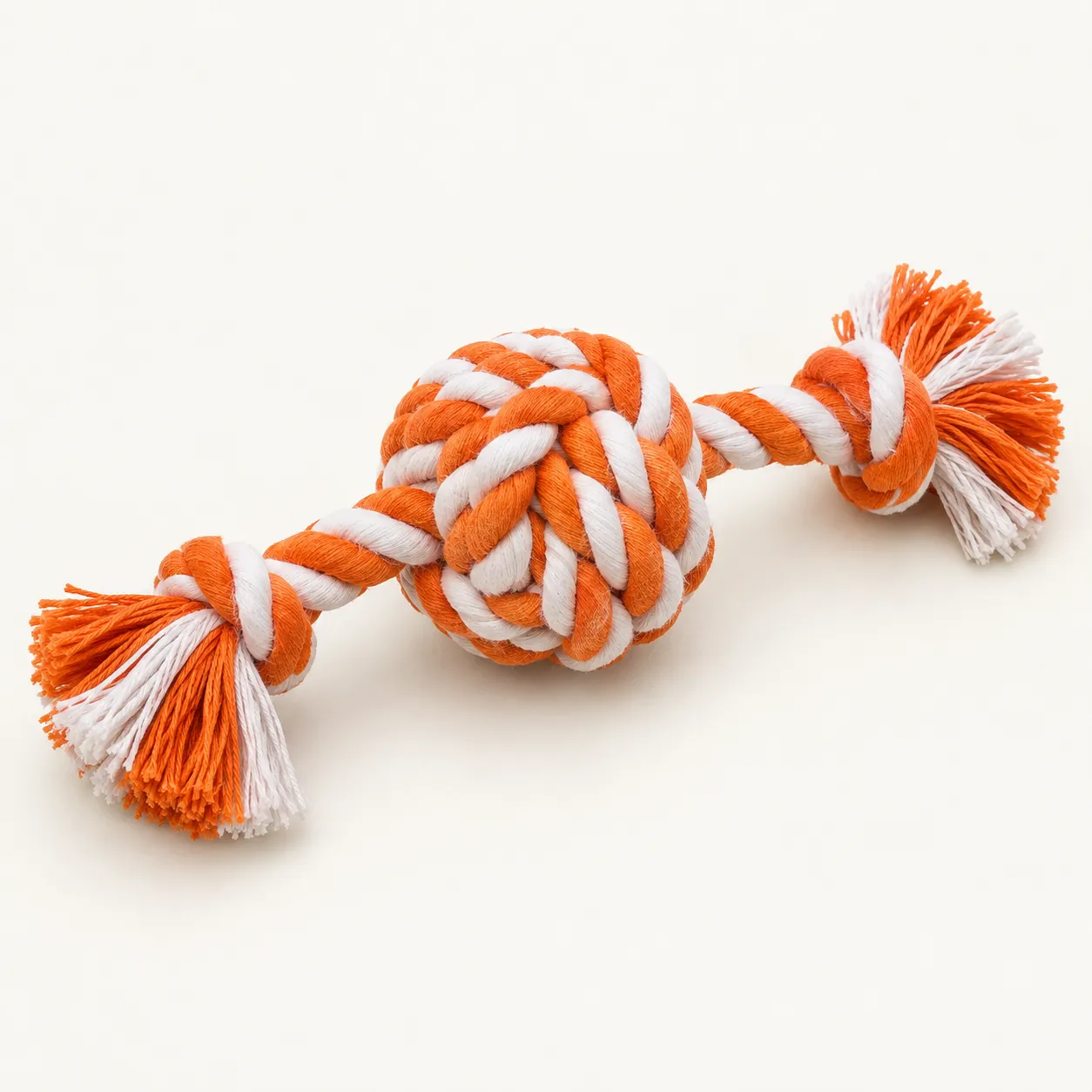
Pawplay's planned Tug Knot is a rope-style example for interactive play. Its final dimensions and material details are not confirmed; the right size is the one that gives you a comfortable grip without crowding your dog's mouth. A rope toy belongs in supervised play. Put it away afterward rather than leaving it for a dog that might shred and swallow fibers.
| Check | Good starting sign | Stop or change course when |
|---|---|---|
| Toy | Fits the dog's mouth with space for your hand | Fibers detach or the toy is too small |
| Body position | Feet stay on the floor; neck looks neutral | Dog is lifted, twisted, or slips |
| Engagement | Dog chooses to rejoin after a pause | Dog retreats, freezes, or looks uncomfortable |
| Release | Dog can trade for a reward | Taking the toy becomes a struggle |
A simple tug routine
- Show the toy and wait for your dog to choose to engage. Do not push it into the dog's mouth.
- Hold it low, moving gently from side to side with the dog's body. Let the dog do most of the pulling.
- Pause after a short bout. Keep the toy still rather than yanking it away.
- Offer a treat or second toy and reward a voluntary release. Then invite another round if your dog still wants one.
- End while the game is friendly. Trade for the toy, praise the dog, inspect the toy, and put it away.
The AKC suggests short bouts with breaks and emphasizes keeping the dog's spine in a neutral position and its feet low. No fixed session length fits every dog. Adjust to age, fitness, play style, and how the dog responds that day.
Teach a release as a trade
The goal of a release cue is cooperation, not a contest. Start when your dog is already comfortable with the toy. Pause movement, present something worth swapping for, and reward the moment the dog lets go. Give the toy back when it is appropriate so the dog learns that releasing it does not always end the fun. The AKC's trading guide describes this approach with toys and treats.
Do not pry a toy from a dog's mouth or scold a dog for not understanding the cue yet. If a dog guards toys, stiffens when you approach, or has bitten over possessions, stop using tug as a training exercise and ask a qualified reward-based professional for help. The AVSAB's training guidance recommends reward-based methods and rejects intimidation and physical punishment.
Technique matters more than force
Avoid swinging your dog, lifting the front paws, or snapping the toy upward. Keep resistance modest and the toy near the dog's natural head height. A stronger pull is not a better game. For young, small, older, or physically limited dogs, gentler resistance and shorter bouts are especially sensible. If your dog shows discomfort, stops using one side of its mouth, limps, or seems reluctant to move, end the game and seek veterinary advice.
Letting the dog win a round can keep tug collaborative. You can invite the dog to bring the toy back, or trade for it, without making possession a battle. A dog that no longer wants to play has answered the question for that moment; put the toy away and offer rest or another activity. Tug should remain optional for both partners.
When tug is not the right activity
Some dogs simply do not like it. Try a short sniffing game, a food puzzle, or a calm walk instead. Dogs that become overexcited and cannot pause may need an easier game and practice with releases outside an intense tug session. A household with several dogs should avoid turning one tug toy into a contested resource. Separate the dogs and supervise each play session.
Inspect the toy every time. The ASPCA's chew position asks owners to match items to a dog's chewing habits, observe use, and remove damaged objects. Frayed rope and loose fragments are reasons to retire a tug, even if it still looks playable in a photograph.
The end of the game is part of the game
A clear finish helps make tug easy to repeat. Offer a trade, wait for the release, praise, and store the toy out of reach. You do not need to force a final win. The useful outcome is a dog that can engage, pause, and disengage comfortably with you. If the dog prefers a gentler version tomorrow, follow that lead. Play is a relationship, and the dog should have room to opt in or out.
If your dog wants to keep the toy after a release, that does not automatically mean the game has gone wrong. Offer an alternative reward and give the dog time to respond. Practice the trade when nobody is rushed, rather than trying to teach it in the middle of an intense bout. A dog that cannot comfortably pause may be better served by a quieter game that day. Store the rope only after the exchange has finished, so the ending stays predictable.
Common questions
A well-managed game can be enjoyable, but fit, gentle technique, and the individual dog's comfort matter.
No. Let the dog win sometimes, and use an easy trade when you need the toy back.
Pause the game and offer a reward or another toy. Reward a voluntary release, then restart play when appropriate.
Replace it when fibers fray, knots loosen, or pieces could detach and be swallowed.